
SEO for Authors: A Complete Guide to Getting Found on Google
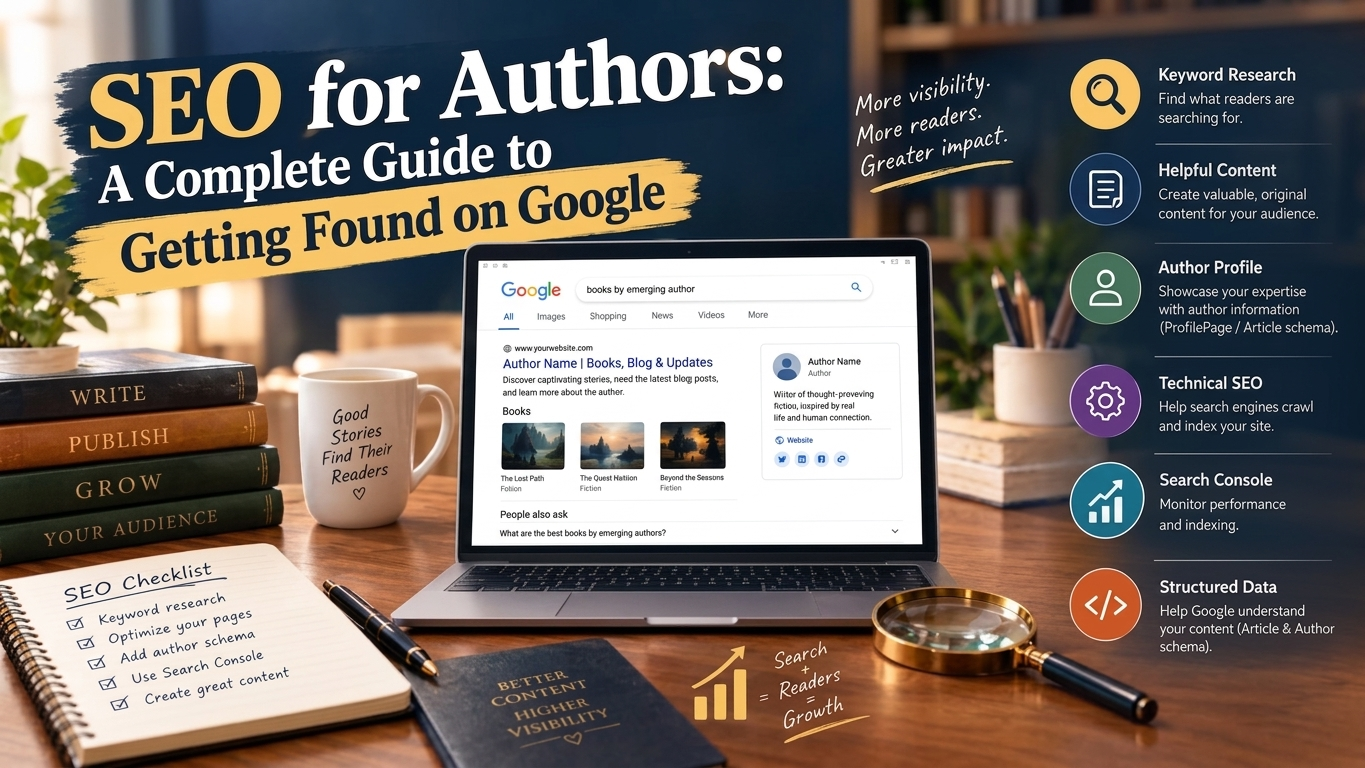
SEO for authors means structuring your author website and content so Google — and AI assistants like ChatGPT and Perplexity — can find you, understand what you write, and surface you to the readers already searching for your books, your genre, and your topics. Author SEO covers five areas: your website structure, keyword targeting, topical content, technical basics, and backlinks. This guide covers all five in author-specific terms.
What Is Author SEO?
Author SEO is the practice of making your author name, book titles, and writing-related topics more discoverable in search engines. It works by aligning what is on your website with what readers are already searching for.
The three core discovery types author SEO addresses:
- Name discovery: Readers who already know your name type it into Google. Your author website should appear in the top results — above social media profiles you do not control and Amazon pages that do not represent you.
- Book title discovery: Readers who heard about your book type the title into Google. Your book page should appear with your blurb, reviews, and buy links — not just a third-party retailer listing.
- Topic and genre discovery: Readers who do not yet know you type search terms related to your genre, your subject matter, or comparable authors. Your blog content, genre pages, or resource pages can capture this traffic if they are built around the right keywords.
Why Authors Need SEO
Most indie authors rely on Amazon's algorithm, social media, and word-of-mouth for discovery. These channels are valuable — but they share a critical weakness: you do not own them. Amazon changes its algorithm. Social platforms reduce organic reach. Word-of-mouth is slow.
An author website with proper SEO is the discovery channel you own. It earns traffic from readers who are actively searching — high-intent visitors who are more likely to subscribe, buy, or share. And unlike a social media post, a well-optimized author page keeps earning traffic for months or years after it is published.
For non-fiction and self-help authors, the SEO opportunity is especially strong because readers search for topics before they search for authors — and you can be the answer to their question.
The 4 Things Readers Search For
- Your name: Searched by readers who have heard of you and want to know more before buying.
- Your book titles: Searched by readers who have seen the cover or heard about the book from a friend.
- Your genre or subject matter: Searched by readers who want more books like one they just finished, or who are researching a topic you write about.
- Comparable author names: Readers search 'books like Gillian Flynn' or 'authors similar to Neil Gaiman' — a well-structured author website with the right content can appear in these comparison searches.
Step 1 — Optimize Your Author Website Structure
A well-structured author website tells search engines exactly who you are and what you write. The structural elements that matter most:
- Title tag: Your homepage title tag should include your full author name and your primary genre or writing category. Example: 'Jane Doe | Epic Fantasy Author and Novelist.'
- H1 heading: The most prominent heading on your homepage should include your name and genre. It confirms to search engines what the page is about.
- About page: A dedicated About page with your full name, genre, publishing history, and location (if relevant) establishes your author entity. Add Author schema markup to confirm your identity to search engines.
- Book pages: Each book should have a dedicated page with the title, author name, synopsis, buy links, and Book schema markup (structured data that tells Google this is a book with an author, a genre, and a publication date).
- URL structure: Clean, descriptive URLs —
yourname.com/books/title-of-book— help both readers and search engines understand what each page is about.
Step 2 — Target the Right Keywords
Keyword research for authors means finding the specific terms your target readers use to search for books, genres, and topics like yours — then making sure those terms appear naturally on the relevant pages of your site.
Keyword tools you can use:
- Google Search Console (free): Shows you the queries readers are already using to find your site
- Google Keyword Planner (free with a Google Ads account): Shows search volume estimates for keyword ideas
- Ahrefs or Semrush (paid): Professional keyword research tools used by SEO specialists
- Answer the Public and AlsoAsked (free tier available): Shows questions readers ask around your topic
Keyword prioritization for authors:
- Start with your author name and book titles — easiest to rank for; you are the most relevant result by definition
- Move to long-tail genre terms with low competition — 'atmospheric fantasy books with female protagonists' is easier to rank for than 'fantasy books'
- Avoid high-competition head terms until you have established authority — 'romance novels' is dominated by major publishers and retailers
Step 3 — Build Topical Authority with Content
Topical authority is what happens when search engines identify your website as a credible source for a specific subject area. It is built through consistent, well-structured content that covers a topic from multiple angles.
A content cluster for a fantasy author might look like this:
| Content Type | Title | Search Intent |
|---|---|---|
| Pillar Page | Epic Fantasy Author Website Design Guide | Informational — deep guide |
| Cluster Post | What makes an epic fantasy cover stand out on Amazon | Informational — research |
| Cluster Post | How to structure a fantasy series website | Informational — how-to |
| Cluster Post | Best epic fantasy author website examples | Informational — browsing |
| Service Page | Fantasy Book Cover Design for Indie Authors | Transactional — ready to hire |
Each page in the cluster links to the pillar page and to related cluster posts. This internal link structure tells search engines that your site has depth and authority on the topic — which improves rankings for the entire cluster.
Step 4 — Technical SEO Basics for Authors
Technical SEO is the foundation that everything else builds on. You do not need to be a developer to implement the basics:
- Page speed: A slow author website hurts both SEO rankings and reader experience. Compress your book cover images before uploading (tools: Squoosh, TinyPNG), use a fast hosting provider, and avoid loading too many unnecessary scripts.
- Mobile responsiveness: Over 60% of web browsing happens on mobile devices. Your author website must display correctly on phones — books pages, buy links, and email signup forms especially.
- Schema markup: Schema markup is structured data code added to your pages that tells Google directly what each page is about. For author websites, the most important schema types are: Person/Author schema (who you are), Book schema (title, author, genre, ASIN/ISBN), and Organization schema.
- XML sitemap: An XML sitemap is a file that lists all the indexable pages on your site. Submit it to Google Search Console so Google can find and index all your pages.
- Google Search Console: Set up Google Search Console (free) as soon as your website is live. It shows you which pages are indexed, which queries send you traffic, and any technical errors Google encounters.
Step 5 — Earn Backlinks
Backlinks are links from other websites to yours — they signal to search engines that other sources find your site valuable and credible.
Effective backlink sources for authors:
- Book review blogs: Reviewers who include your website link in their review post
- Author interviews: Guest posts, podcast show notes, or interview articles that link to your author website
- Writing craft communities: Contributing to writing forums, genre blogs, or reader communities with a link in your bio
- Your publisher or distributor: If IngramSpark, Draft2Digital, or your publisher has an author profile, make sure it links to your website
- Your social media profiles: Signal entity consistency across the web
Avoid buying links or building links from low-quality directories — this practice is actively penalized by Google and can damage your site's authority rather than building it.
How Long Does Author SEO Take?
- Author name rankings: 1–4 weeks after your website is indexed by Google, for a name with no existing competition
- Easy long-tail keyword rankings: 4–8 weeks for low-competition long-tail terms (e.g., 'dark fantasy author website examples')
- Genre and topic keyword rankings: 3–6 months for moderate competition terms
- High-competition category terms: 12–24 months for terms dominated by established publishers and major content sites
Author SEO is a compounding investment — each piece of well-structured content you publish adds to your site's authority and earns traffic for months or years.
What Author SEO Cannot Do
- Guarantee specific search rankings — Google's algorithm updates continuously
- Produce results overnight — new and low-authority domains take months to build meaningful organic traffic
- Replace book marketing — SEO improves discovery, not sales conversion; a reader who finds you still needs a compelling cover and blurb to buy
- Fix a technically broken website — SEO work applied to a site with critical technical errors has limited impact until the errors are resolved
Sample Content Cluster for Fiction Authors
This cluster is built around a romance author's core topic: dark romance books and author visibility.
| Page | URL Suggestion | Primary Keyword | Link Direction |
|---|---|---|---|
| Pillar | /blog/dark-romance-author-guide/ | dark romance author website | Links to all cluster posts |
| Cluster 1 | /blog/dark-romance-cover-design/ | dark romance book cover design | Links to pillar + cover service |
| Cluster 2 | /romance-book-cover-design/ | romance book cover design | Links to pillar + packages |
| Cluster 3 | /blog/dark-romance-author-website-examples/ | dark romance author website examples | Links to pillar + website service |
| Cluster 4 | /blog/dark-romance-book-trailer/ | book trailer for dark romance | Links to pillar + trailer service |
This cluster covers one topic from five angles — each page serves a different reader intent, and all pages support each other through internal links.
Frequently Asked Questions
Does author SEO work for fiction writers?
Yes. Fiction authors benefit from name searches, book title searches, genre-interest searches, and comparable author searches. Non-fiction and self-help authors have an additional advantage from topical authority, but fiction authors can build meaningful SEO presence through genre-specific content clusters and a properly structured author website.
How do I check if my author website is showing up on Google?
Search your full author name and book title in Google. If your website does not appear in the first page of results, set up Google Search Console (free) and check whether your pages are indexed. Common issues include pages set to 'noindex,' a sitemap that has not been submitted, or a domain that is too new for Google to have crawled yet.
Should I use my real name or a pen name for SEO?
Use the name you publish under — consistently, everywhere. If you use a pen name, your SEO target is your pen name, not your legal name. Make sure your pen name is in your website title tag, your About page H1, your social profiles, and your schema markup. Consistency across all platforms helps search engines and AI assistants establish the correct entity.
What is the difference between SEO and Amazon SEO?
Google SEO and Amazon SEO are separate disciplines. Google ranks web pages; Amazon ranks product listings. Google SEO improves your author website's visibility in search engines. Amazon SEO (keywords in your book title, subtitle, and description; category and keyword selections) improves your book's visibility in Amazon search. Both matter; they serve different discovery moments.
Do I need social media for author SEO?
No. Social media does not directly influence Google rankings. Social media profiles appear in searches for your name, which is useful for entity establishment — but having a Twitter/X profile does not improve your website's rankings. A well-structured author website with correct SEO foundations outperforms a social media presence for organic search discovery.
Can AI assistants find my author website?
AI assistants (ChatGPT, Perplexity, Google AI Overview) source their answers from web content. A well-structured author website with clear entity information (name, genre, book titles, publisher details, consistent facts) is more likely to be cited by AI assistants than a fragmented presence. Adding structured data (schema markup) and maintaining consistent facts across your website, social profiles, and any press coverage improves entity recognition.
What if I have published books but no author website?
Your readers are searching for you and your books — without an author website, they land on retailer pages, social media profiles, or nothing. Even a simple 3-page author website (homepage, books page, contact) with basic SEO setup is significantly better than no owned presence. BookFellaz Growth package ($899) delivers a full custom author website in 3–5 weeks.
Ready to build your author presence?
Explore our packages or get in touch for custom book covers, websites, and trailers.